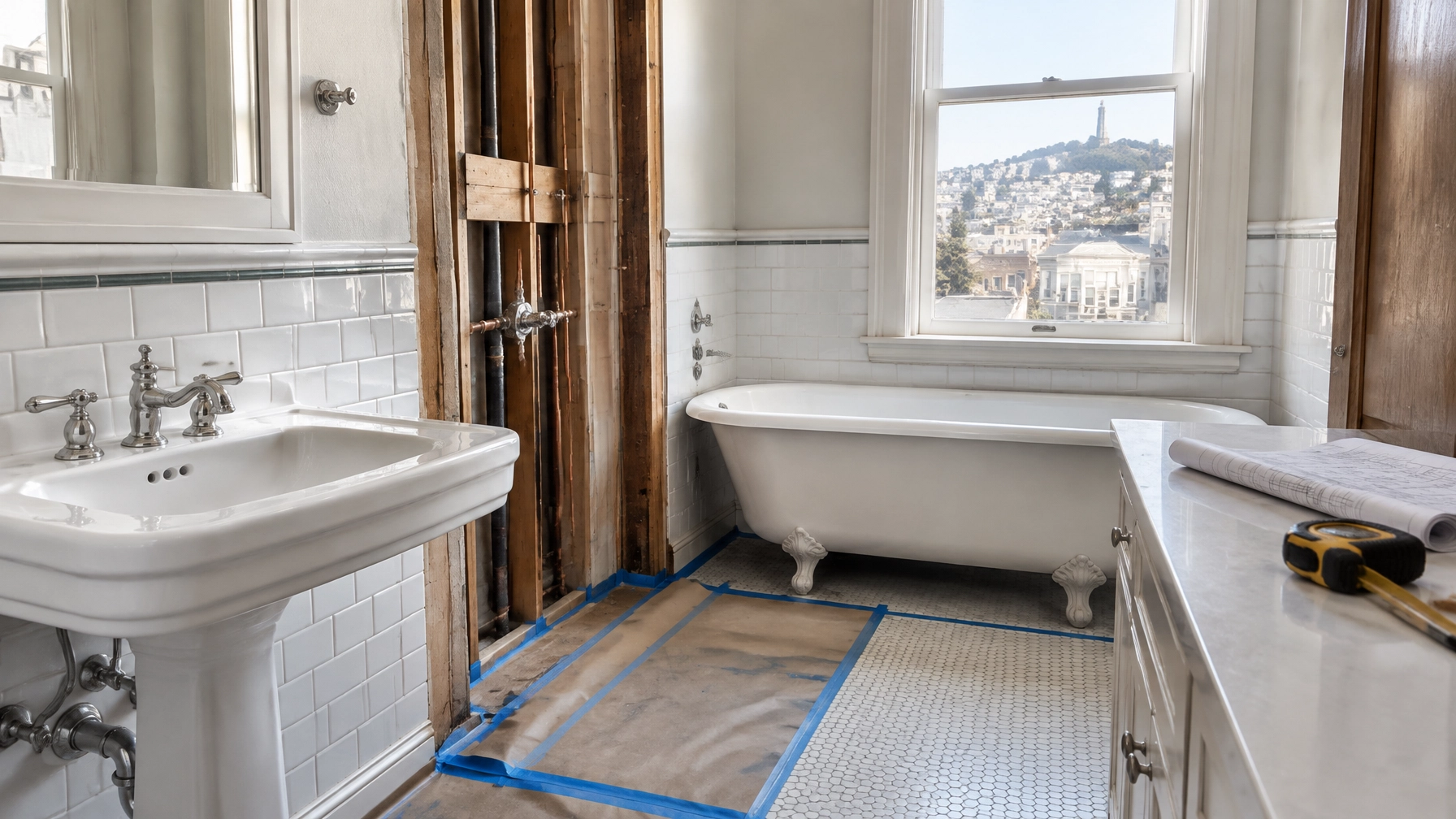
The San Francisco Chronicle launched a residential permit data map this week, showing where roughly 8,000 home improvement projects were marked complete across the city between July 2025 and June 2026.
For San Francisco homeowners considering a renovation, it's the most accessible view of what neighbors have actually done in the last year — bathrooms, kitchens, windows, doors, roofs, solar, and ADUs, all filterable by category and location.
But the Chronicle's map contains one number that tells only half the story, and one implication that homeowners need to understand before they file their own permit.
What the Chronicle's data actually shows
The map plots completed permits — not started, not in-progress, but marked complete by the San Francisco Department of Building Inspection. This is useful because it filters for projects that actually finished.
The Chronicle reports these median permit valuations:
- Bathroom-only permits: $28,000 median valuation
- Kitchen-only permits: $35,000 median valuation
Those numbers are geographically accurate but conceptually incomplete.
The gap between permit valuation and actual project cost
The Chronicle's article quotes San Francisco architect Ernie Selander:
"The most basic bathroom remodel in San Francisco... I'd used to tell people $60,000. The most basic kitchen remodel you can do (costs) $100,000."
So which number is right — the $28,000 median permit valuation or the $60,000+ that an experienced architect quotes for a basic project?
Both. They measure different things.
Permit valuation is the number filed with DBI when the permit is pulled. It's supposed to reflect the value of the work being done. It's declared by the applicant (usually the contractor). Higher valuation means higher permit fees and can affect assessor review triggers.
Actual project cost includes labor, materials, contractor markup, plumbing and electrical sub-permit fees, permit fees themselves, unforeseen conditions discovered mid-project, and finish selections. It's typically significantly higher than the declared permit valuation.
The practical gap between the two — as illustrated by the Chronicle's $28K median vs. Selander's $60K quote — is why using permit valuation data to budget a renovation will leave you meaningfully short.
If you're using the Chronicle's map for budgeting, expect actual all-in project costs to be substantially higher than the declared valuations shown.
What the property tax note actually means
The Chronicle's article briefly mentions that permits can trigger assessor review, potentially increasing property tax. This is worth understanding.
Under California Proposition 13, your property's assessed value only changes at two moments: when the property is sold (reset to purchase price) OR when the property undergoes what California Revenue and Taxation Code Section 70 defines as "new construction" — broadly, an addition to the property, or an alteration/rehabilitation substantial enough to be the equivalent of new construction. Routine repairs, maintenance, and minor alterations that don't materially increase value don't count. Routine maintenance and repairs don't trigger reassessment. Most cosmetic upgrades don't either.
What DOES qualify as new construction under Prop 13 depends on specifics. Assessors evaluate whether the work adds substantial value beyond ordinary repair. Some renovations that seem "just a remodel" can be classified as new construction if they add square footage, add fixtures, or substantially improve the property. Kitchen and bathroom remodels are evaluated on a case-by-case basis.
The practical impact: if the assessor determines your renovation added assessed value, that added amount gets taxed at your local rate. San Francisco's secured property tax rate for FY2025-26 is approximately 1.18% of assessed value (per the San Francisco Treasurer & Tax Collector's office); the effective rate can run somewhat higher on individual properties once voter-approved bonds and assessments are factored in. The annual increase is permanent and continues over the life of your ownership.
What this means for you:
- Never let this scare you into skipping the permit (unpermitted work has much worse resale consequences)
- Consider the long-term tax cost when deciding scope, especially for major renovations
- Consult the San Francisco Assessor-Recorder's office or a licensed real estate attorney for guidance specific to your project
What the Chronicle's map doesn't tell you
The Chronicle mapped what other people did. It doesn't help you plan what YOU should do. Specifically:
It doesn't tell you which permits YOUR project needs. The Chronicle categorizes by scope (bathroom, kitchen, etc.) but doesn't distinguish between the multiple sub-permits a typical bathroom or kitchen renovation actually requires (building permit plus separate plumbing, electrical, and sometimes mechanical sub-permits).
It doesn't tell you your project's timeline. Completed permits show a static snapshot. Your project's timeline depends on scope, review track (OTC vs in-house), correction rounds, and property-specific factors the map doesn't capture.
It doesn't tell you property-specific factors. Historic district, Coastal Zone, Special Use District, prior unpermitted work — all of these change your permit path and cost. The map shows what neighbors did, not what applies to YOUR address.
It doesn't tell you the code-triggered upgrades your project might require. San Francisco's all-electric renovations ordinance, recent California code updates, Bay Area Air District rules affecting gas appliances — none of these show in historical completed data.
How to actually use this data
The Chronicle's map is useful as one input among several. Here's how to make it actionable:
1. Look at 5-10 completed projects in your neighborhood. Same project type, similar scope. Read the permit descriptions. This gives you a realistic sense of what's typical for your area.
2. Recognize the permit valuation is not the full project cost. Use the map for relative comparisons across neighborhoods and project types, not for budgeting.
3. Factor in potential property tax reassessment for major projects. For renovations beyond routine maintenance, consult the San Francisco Assessor-Recorder's office about whether your specific scope may trigger reassessment.
4. Determine your specific permit requirements before finalizing scope. Use a permit planning tool or consult a San Francisco-experienced contractor to identify which specific permits and sub-permits your project needs.
5. Get an actual contractor bid before finalizing budget. Historical valuation data tells you very little about what your project will actually cost. A licensed contractor bid tells you your project's real number.
The bigger picture
The Chronicle's map is a genuinely useful contribution to San Francisco renovation transparency. Getting DBI data out of PDF reports and into an interactive map is a real improvement over what existed before.
But permit data alone doesn't answer the questions homeowners actually ask:
- "Which permits do I need for MY specific project?"
- "How much will it really cost, all-in?"
- "What's the property tax impact?"
- "How long will it take?"
- "What property-specific factors apply?"
Historical data shows what happened. Planning tools show what you should do next. Both are useful. Neither replaces the other.
Related guides
Sources
Want to know exactly which permits YOUR San Francisco project needs, what they'll cost, and how long they'll take? Permit Compass analyzes your specific project scope, address, and property factors — for $49.