Posted: July 4, 2026. Updated August 25, 2026. Source: San Francisco Fire Department / SFist / San Francisco Board of Supervisors.
The summary: San Francisco's Board of Supervisors approved a delay to the sprinkler retrofit mandate for pre-1975 high-rise condos on April 21, 2026, shortly after a unanimous Land Use and Transportation Committee vote in February. The ordinance was signed on April 30 and became effective June 1. The rule affects roughly 9,800 units across 126 buildings, mostly in Nob Hill, Telegraph Hill, the Marina, Pacific Heights, and Russian Hill. Per the San Francisco Fire Department's official compliance guidance, the schedule is staged across three steps: permit-application submission by January 1, 2032; water-supply and sprinkler-riser installation by January 1, 2034; and full system completion by January 1, 2035. A separate exemption for certain Residential Group R-2 occupancies also expires January 1, 2035. A newer city-commissioned cost report, released August 10, 2026, found actual installation costs vary far more widely by building than earlier estimates suggested.
What the city decided
The original mandate — added via a 2022 fire code update, now Section 1103.5.4 of the San Francisco Fire Code — requires buildings with an occupied floor more than 120 feet above fire department vehicle access (or between 75–120 feet without two fire-rated exit stairways or a compliant fire alarm system) to install automatic sprinkler systems. Earlier retrofit estimates varied widely, and condo owners argued the requirement was adopted without an adequate feasibility study of what it would actually cost them.
More than 100 condo owners packed a February 24, 2026 committee hearing. They argued the mandate had already depressed property values, made units difficult to sell, and could put some owners underwater. Realtor Dona Crowder testified that "with a stroke of gavel you have taken money out of these people's pockets."
The committee responded with unanimous approval to delay the permit-application deadline and appoint a study process examining the mandate's feasibility. The full Board of Supervisors approved the delay on April 21, 2026; the ordinance was signed on April 30 and became effective June 1. This is no longer pending, contrary to earlier reporting on the committee vote alone.
The official staged deadline structure, per the San Francisco Fire Department's compliance guidance (2025 San Francisco Fire Code, Section 1103.5.4, as amended):
- Step 1 — Permit application submission: by January 1, 2032 (previous deadline: January 1, 2027)
- Step 2 — Water supply and sprinkler-riser installation: by January 1, 2034 (previous deadline: January 1, 2031)
- Step 3 — Full system completion: by January 1, 2035
- R-2 occupancy exemption (for units classified R-1 prior to 2008): expires January 1, 2035
Some secondary press coverage published around the time of the Board vote reported the permit-filing deadline differently (as 2031 rather than 2032), and even reporting as recent as August 2026 noted ongoing confusion in press coverage about the exact dates. The dates above come directly from the San Francisco Fire Department's own post-amendment compliance page, which is the most authoritative source available, and supersede any conflicting secondary reporting.
In other words: 2032 is when affected buildings need to have filed for permits, 2034 is when the water supply and riser need to be installed, and 2035 is the deadline for full system completion — not a single "mandate pushed to 2032" event.
The Board's ordinance (No. 74-26, File No. 260216) also established an 11-member Technical Advisory Council to advise the Board, the Mayor, and the Fire Department on alternate-method requests, waivers, and hardship extensions, including consideration of financial hardship and displacement risk.
What it means for San Francisco condo owners
If you own a pre-1975 high-rise condo in the affected neighborhoods:
You have more runway than the original 2027 deadline gave you, but the mandate itself hasn't gone away — it's now a staged timeline running through 2035. Watch for further developments from the new Technical Advisory Council; hardship and alternate-method requests are now explicitly part of the process.
If you're considering buying in one of the 126 affected buildings:
Know that the retrofit obligation still exists on the extended timeline. The city-commissioned cost report released August 10, 2026 found wide variation in actual installation costs — some older or harder-to-retrofit buildings could face costs in the hundreds of thousands per unit, while many of the 126 affected buildings may see costs closer to the tens of thousands per unit using less invasive installation methods, according to that report. Factor this uncertainty into your offer price, and ask the seller for documentation of the building's egress stairwell configuration — if the building already has two 2-hour fire-rated stairwells, it may qualify for exemption.
If you're doing a renovation in one of these buildings:
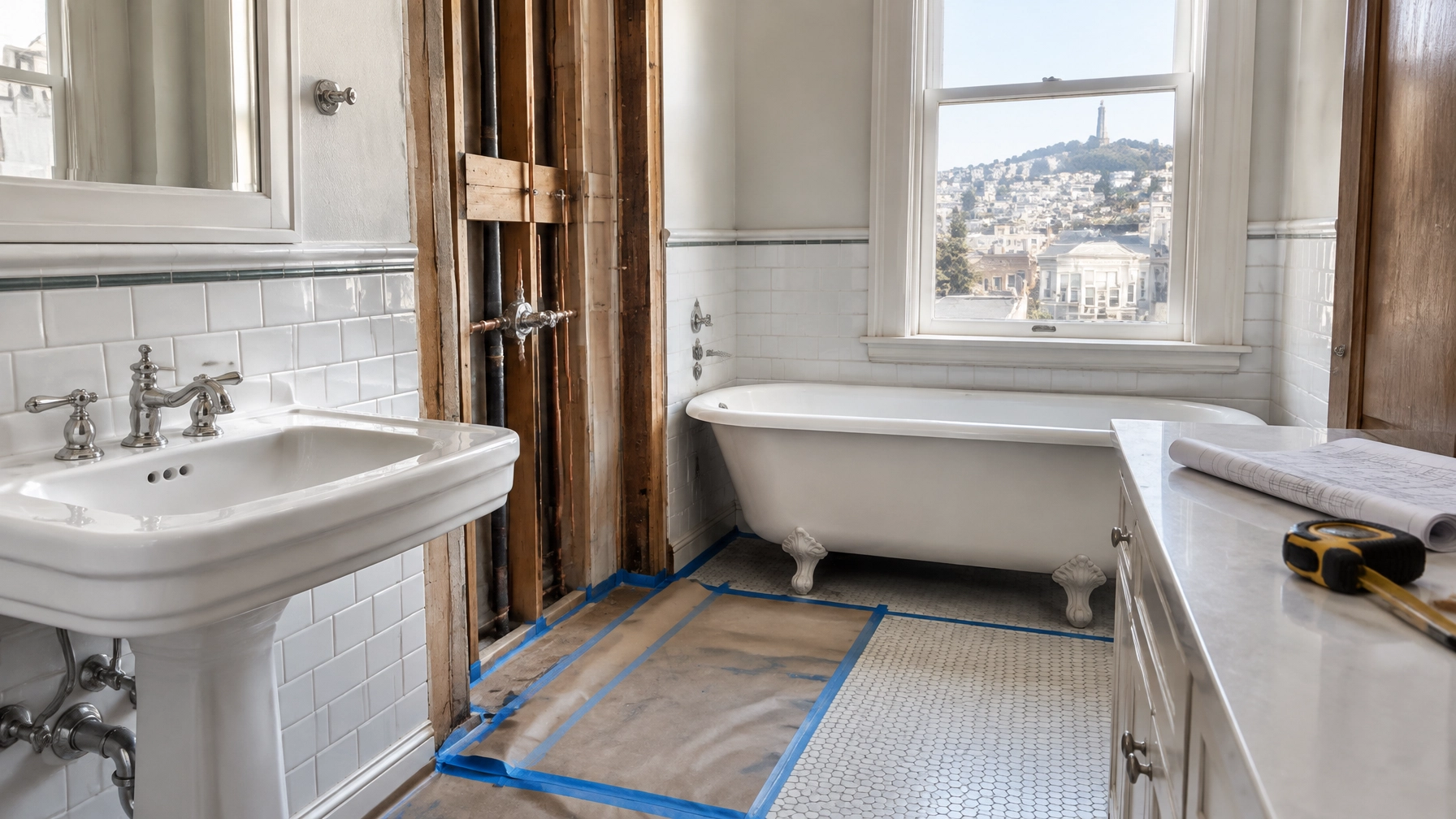
This is worth discussing with your architect. If you're already opening walls for a kitchen or bathroom remodel, adding sprinklers voluntarily could cost less than a standalone retrofit later, though we don't have a sourced figure for the exact savings. The hazardous materials concern raised at hearings — asbestos in older buildings — is real and could add meaningfully to your project cost if not planned properly. Get a licensed asbestos inspection before finalizing scope.
If your building already has sprinklers or may meet an alternative condition:
Do not assume you are unaffected based on stairways alone. Under the San Francisco Fire Department's official guidance, the two-hour stairway or compliant-fire-alarm alternative applies to buildings in the 75–120-foot condition; buildings with an occupied floor more than 120 feet above fire department vehicle access remain subject to the sprinkler requirement. Ask your HOA and the Fire Department to confirm your building's height, stairway and alarm configuration, existing sprinkler status, and applicable category.
Do you need to do anything different?
For most owners: no immediate action required beyond staying informed, since the permit-application deadline isn't until January 1, 2032.
Three things worth doing over the next year:
1. Confirm your building's status. Ask your HOA whether the building is on the affected list and, if so, whether it currently meets any exemption criteria. Don't assume — many older buildings have modifications that could exempt them.
2. Get your building's specific cost estimate. Given how much the August 2026 cost report shows actual bids can vary by building, ask your HOA to get a building-specific engineering estimate rather than relying on citywide averages when budgeting or setting special assessment expectations.
3. If planning a renovation, discuss potential integration with your architect. Even on the extended timeline, some form of eventual compliance is likely. Renovations that already open walls (kitchen, bath, whole-unit remodel) may present an opportunity to add fire safety features at lower marginal cost than a standalone retrofit later — get a specific quote rather than assuming a fixed percentage savings.
The original sources
Read the original reporting on SFist: Nob Hill and Marina Condo Owners Have Just About Secured a Delay on That Pricey Sprinkler Mandate (February 24, 2026).
For the current cost picture, see SFist's coverage of the newer report: City-Commissioned Report Confirms That, For Some Older Buildings, Sprinkler System Installation Will Be Very Pricey (August 10, 2026).
For the authoritative, current compliance schedule, see the San Francisco Fire Department's official guidance on the 2025 Fire Code amendments to Section 1103.5.4.
Get your project's current permit list
Permit Compass tracks fire code changes, San Francisco DBI Director's Bulletins, and Planning Code updates that affect San Francisco renovation projects. If you're planning work in a building potentially subject to fire safety requirements, we'll flag it in your permit plan.
→ Get your specific permit guidance — $49
Related reading: